
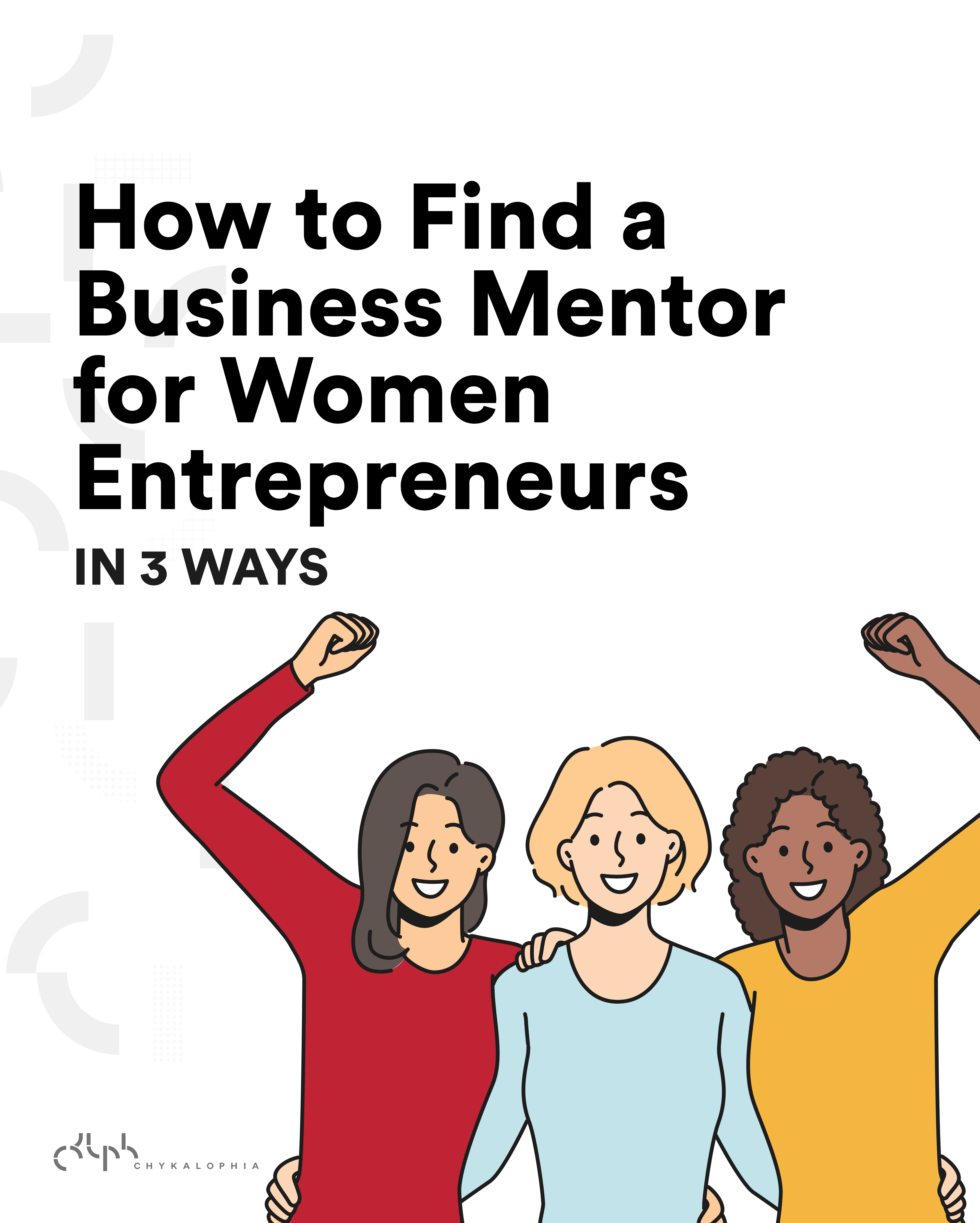
How to Find a Business Mentor for Women Entrepreneurs in 3 Ways
Mentorship has always been a big part of our growth as a company. Our CEO, Ari Krzyzek, began to find a business mentor more than a decade ago when Chykalophia was just a tiny seed in a big garden.…
Mentorship has always been a big part of our growth as a company. Our CEO, Ari Krzyzek, began to find a business mentor more than a decade ago when Chykalophia was just a tiny seed in a big garden. And thanks to the amazing mentors Ari encountered, we've grown from earning $250 a month to a six-figure agency!
How does mentorship work, especially for women entrepreneurs? How do you find a good mentor and how exactly can you learn from them?
Why is mentorship important for women entrepreneurs?
In general, mentorship provides aspiring entrepreneurs with the knowledge, confidence, networks, and ongoing support necessary to thrive in the business world. It also promotes diversity and inclusion in the entrepreneurial landscape, providing fairer opportunities for everyone and anyone (including women and women of color) who wants to start a business.
Benefits of mentorship for women entrepreneurs
Women entrepreneurs usually try to find a business mentor to help them overcome gender-related obstacles, but that's not the only advantage you can get from having a business mentor.
- Personalized guidance: You have access to more experienced entrepreneurs who can offer guidance and share their knowledge, different perspectives, experiences, extensive networks, and mistakes they had learned from. All of these are tailored to your personal situations and business needs, so they're more relevant and effective than the general advice you seek on the internet.
- Beat impostor syndrome: It's easy to lose confidence and experience self-doubt in male-dominated industries. Your mentor has been helping you set your goals and holding you accountable for your progress, and they can help remind you of what you've achieved so far, restoring your faith in your capabilities.
- Overcome gender barriers: It's unfortunate but true that women entrepreneurs may still face gender-specific challenges and biases. A mentor who has navigated similar challenges can offer guidance on addressing gender-based discrimination, negotiating for fair opportunities, and fostering an inclusive workplace culture.
The fastest way to lose a mentor is to ask for one before you've earned the conversation.
How to find a business mentor for women entrepreneurs
It's actually not difficult to find a business mentor. You just need to know where and how to approach them, as well as your goal of having a mentor.
Approaching a mentor
True story: our CEO once got rejected right in her face when she asked someone to be her mentor. Ouch! That hurts. But it was probably a bad move from Ari because they hadn't really connected yet. She found this mentor's online presence and knowledge admirable and went straight to ask about mentorship.
Don't repeat her mistake. We recommend that you approach and connect online first with your potential mentors. Be friends with them and see if they’re interested in mentoring. Other than personal LinkedIn profiles or YouTube channels you find interesting, you can also join groups or communities that connect women mentors and mentees, such as:
- Femtech Lab
- adplist.org
- 1871
- Chicago Innovation Mentorship Programs
- The 10th House
How to do it
- Make a short list of people whose work you actually admire on LinkedIn or free platforms like ADPList and MicroMentor.
- Warm the connection first: comment with substance, share their work, ask one specific question before asking for anything.
- Book a low-stakes intro session (ADPList and SCORE both run free 1:1s) instead of opening with 'will you be my mentor.'
- Only raise ongoing mentorship after two or three genuine exchanges.
See a worked example
For example, instead of DMing a stranger 'will you mentor me,' you might spend three or four weeks genuinely engaging with their work first: leaving a specific comment on a post, sharing their newsletter with your own take, then booking a single free intro session and asking one real question. If a mentorship forms, it usually grows out of that, not out of the label.
Tools to use
ADPList for free 1:1 sessions with volunteer mentors, MicroMentor to browse volunteer business mentors, and SCORE for free SBA-partner mentoring matches.
Steal our AI prompt
You are helping me write a warm, non-transactional first message to a potential mentor. Here is their background and recent work: [paste their LinkedIn About section and one or two recent posts]. Here is who I am and what I do: [describe your business, stage, and the specific thing I admire about their work]. Write a message under 120 words that references something specific they published, asks one genuine question, and does NOT ask them to mentor me yet. Give me two versions, one slightly warmer and one more concise.
Organic vs. structured mentorship
Define your goal before building a connection with a potential mentor, as it will determine what mentorship approach to take.
Organic mentorship typically happens naturally. You connect with a more seasoned woman entrepreneur, hit it off, and start becoming a mentor and mentee without knowing it. It's more like building a close relationship and can be great if you're aiming for a self-development type of mentorship.
However, if you aim to build or grow your business, achieve certain KPIs, and see tangible results, it's best to opt for a structured, outcome-based mentorship. You and your mentor should start by making a strategy and plan to achieve your business goals, then have regular meetups for training and check-ins to track your progress.
How to do it
- Write your goal in one sentence, then choose: relationship-led (organic) or outcome-led (structured)?
- For a structured track, set two or three measurable targets and a recurring cadence; SCORE and SBA Women's Business Centers offer free structured counseling to anchor it.
- Send a short agenda before every session so the time goes to decisions, not status updates.
- Revisit the plan each quarter and adjust the targets.
See a worked example
As an illustrative example, 'get better at running my business' is too vague for a mentor to work against, while 'add three retainer clients this quarter at $2k or more per month' gives a structured mentor something concrete to build a plan and check-ins around. The sharper the target, the easier it is for a mentor to be useful.
Tools to use
SBA Women's Business Centers for free structured counseling, Ellevate Network for structured peer-mentoring squads, and SCORE Academy for free courses to frame goals first.
Steal our AI prompt
Act as a business mentorship planner. My goal for the next 90 days is: [describe your goal]. My business context: [paste stage, revenue range, industry, biggest constraint]. Turn this into a structured mentorship plan: two or three measurable targets, a fortnightly meeting cadence, a standing agenda for each check-in, and exactly what I should send my mentor 24 hours before each session so their time is spent on decisions rather than status updates.
Unconventional mentorship
What if you're still not convinced about one-on-one mentorship? Don't worry, there are other options for you.
You can approach and learn from multiple mentors simultaneously, taking in only the top insights from each one. Or you can even take the modeling approach where you learn from the mentor’s podcasts, webinars, books, and others. Keep in mind, though, that you won't be getting unique, personalized guidance if you decide to take this route.
How to do it
- Pick three to five people whose path genuinely resembles your goal, not just the most famous names.
- Follow their long-form content: podcasts like How I Built This, their books, recorded talks.
- Log one concrete tactic per source in a running doc, then test one at a time.
- Accept the tradeoff: this scales your learning but will not give you tailored, personalized guidance.
See a worked example
For instance, you might assemble a 'virtual board' of four founders whose businesses look like where you want to be, follow their long-form interviews and books, and log one concrete tactic from each into a running doc, testing a single tactic at a time so you can tell what actually moved the needle. It scales your inputs, but it will not give you personalized feedback.
Tools to use
How I Built This for 200+ founder interviews (and the companion book that distills the patterns), and The Goal Digger Podcast for a deep back catalog aimed at women entrepreneurs.
Steal our AI prompt
I want to build a 'virtual board of mentors' by learning from people whose path resembles mine. My business and goal: [describe]. Here are three to five founders, authors, or podcasters I want to learn from: [paste names]. For each, suggest the single best long-form resource (a specific book, podcast series, or talk) and a one-line note on what to steal from them. Then give me a simple template to log one tactic per source and a rule for testing only one at a time.
Mentorship for women can open so many doors
Once you find a business mentor who really cares for your growth, you'll see so many new opportunities laid out in front of you: new knowledge, new skills, new connections, and more.
We truly believe in the power of mentorship for women entrepreneurs, the same community we wrote about in our guide to funding for women entrepreneurs. In fact, mentorship has also been a way for us to give back to society. Our CEO mentors young women who aspire to get into business or UX design, and she's open to new mentoring opportunities as well. Feel free to reach out to her on LinkedIn if you're interested in having a mentor.
Keep reading
 Women-owned Business
5 Networking Tips for Women of Color Entrepreneurs
Is your network truly your net worth? Regardless, business owners and entrepreneurs are often on the lookout for networking tips, even more so those that belong to minority groups such as…
 Women-owned Business
Trump Tariffs Survival Guide: 3 Ways Small Businesses Can Adapt
Update: As of April 24, Donald Trump said he could re-impose “reciprocal” tariffs on certain countries within two to three weeks, signaling a potential escalation in global trade tensions. Trump…
 Women-owned Business
Shaping the Future of Agency Leadership: Key Insights from OWN IT 2025
The recent OWN IT 2025 women's agency ownership summit brought together some of the industry's most innovative minds, offering deep insights into the evolution of agency management and growth…
See exactly where your site is losing conversions
Paste your URL and get an instant conversion score. No form to fill out, no sales call.
Weekly strategies for businesses building what's next.
The Next Draft: one email a week on turning B2B websites into pipeline. No fluff, unsubscribe anytime.