
3 Key Tips to Build a Successful MLP (Minimum Lovable Product) for Your Business
Forget MVP, it’s time to build a successful MLP during the early stage of your product development, so you can prioritize user experience from the very start. Many founders, at the beginning of their…
Forget MVP, it’s time to build a successful MLP during the early stage of your product development, so you can prioritize user experience from the very start.
Many founders, at the beginning of their business, dream of creating the next big thing.
“I want my app to be the next Clue” or “I want my period underwear to have a website like Knix’s.”
While these big dreams are essential to keep you going forward, it’s not something to focus on at the early stages of your business.
Putting too much work into ‘the next big thing’ at the start of your business can cost you a lot of hours and dollars, without any guarantee that people will love the result. Worst-case scenario, it could cause the end of your young business.
About 20% of small businesses in the U.S. don’t survive their first year, according to the U.S. Bureau of Labor Statistics. The causes are varied, but the most common one is cash flow issues or low sales, caused by even more varied reasons like lack of proper business plan and marketing.
Let’s avoid that, shall we?
Forget MVP, Start with MLP
Rather than spending months and thousands of dollars to create the perfect product for the first launch, consider focusing on the very basic version of your product. There are several terms for this version, the most widely used ones are minimum viable product (MVP) and minimum lovable product (MLP).
What is the main difference between MVP and MLP?
MVP has just enough features for early users to try. However, the downside of MVP is that it is usually released quickly with minimal features, designs, and testing solely for the sake of data gathering. That being said, your customers can use it, but they may not love it, they just tolerate it.
For that reason, the term MLP gained traction at Amazon, where Jeff Wilke, then CEO of Amazon Worldwide Consumer, pushed the company to build products customers would love rather than merely tolerate. And the next question is…
What is a minimum lovable product (MLP)?
MLP is a product version that is released with just enough features for early customers to love the experience. It’s a sweet spot between a tight timeline and a delightful user experience. And for a result, you will have an early-stage product that:
- Can solve your customers’ problems
- Provides a pleasant user experience
- Makes customers want to keep using it
A simple analogy for MVP vs MLP
Think of MVP as a plain croissant. You can eat it as is, yes, but that’s it. Meanwhile, MLP is a plain croissant that comes with butter and strawberry jam. You can eat it and enjoy it. And if you prefer blueberry jam, that’s customer feedback.
A minimum viable product gets tolerated. A minimum lovable product gets remembered.
Why You Should Focus on MLP First
Building the ‘perfect’ product takes forever, quite literally. There is always room for improvement, that’s why it is better to start with MLP.
Some more reasons why building an MLP version is more recommended for new businesses:
- It saves a lot of time because it takes a relatively shorter time to build a successful MLP with less budget
- You get to test and review things internally and externally with a small number of selected users
- You start building an audience with these selected users
- You receive feedback that you can adapt to the next development phase
- In the long run, you have a more polished product that can stand out among others when you’re pitching to investors.
3 tips to build a successful MLP (Minimum Lovable Product)
If you’re currently building a femtech company and the MLP concept intrigues you, read on. We have compiled several expert tips on how you can build a successful MLP for your femtech business.
Understand the problem and how your product can solve it
As a brand, you may have found your ‘why’. But your product’s ‘why’ can be different.
Your brand’s ‘why’ is about your values, while your product’s is more on the rational side. If you’re building a period tracker, what problem can you solve that other apps haven’t done? Or if you’re creating period underwear, do you offer more advanced materials and a fun, memorable shopping experience on the website?
How to do it
- Fill a Value Proposition Canvas: list your customer's top jobs, pains, and gains before you write a single feature.
- Run 5 short interviews using The Mom Test rules: ask about their life and past behavior, never pitch your idea.
- Circle the one pain your product relieves better than the apps they already use. That sentence is your product's 'why'.
See a worked example
For example, a period-tracker team might assume the winning feature is the most accurate cycle prediction, then run five short customer interviews and discover the sharper unmet pain is discreet logging during the workday. That reframes the whole first build around one job instead of ten.
Tools to use
Strategyzer's Value Proposition Canvas to map jobs, pains, and gains against what you actually solve, and The Mom Test for how to interview customers without leading them.
Steal our AI prompt
You are a product strategist. My product idea: [describe your product in 2-3 sentences]. My target customer: [describe who they are and their situation]. Build me a Value Proposition Canvas: list the top 3 customer jobs-to-be-done, the 3 biggest pains they hit trying to do those jobs today, and the gains they want. Then, for each pain, tell me honestly whether my product relieves it or I am guessing, and give me 5 non-leading, Mom Test style interview questions I could ask to validate the real problem before I build anything.
Remember that it should be ‘minimum’
We know it’s fun to build your product, but don’t get carried away and prepare too many different jams for your croissant. First, serve it with unsalted butter and strawberry jam and collect feedback. In the next round, add salted butter and raspberry jam and gather more data.
Your first MLP needs to focus on its core features. For instance, make sure your MLP is able to track users’ periods, physical symptoms, and mental symptoms. Those sync-with-Google-Calendar or sync-with-Apple-Watch features can come in later versions.
But don’t take ‘minimum’ too seriously, either, because that would be MVP. Allocate some time to create a nice-looking UI and sharp copy, and make sure everything runs seamlessly.
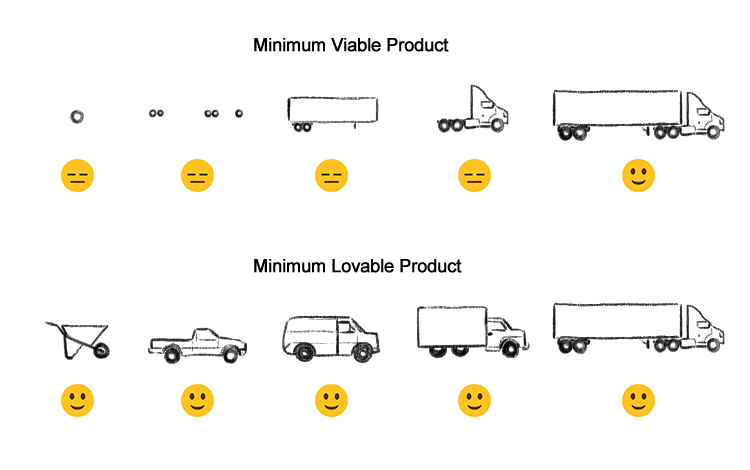
Below is a good illustration of differentiating MLP and MVP to help you find that sweet spot.
How to do it
- Dump every candidate feature into one list, then score each with RICE (Reach x Impact x Confidence, divided by Effort).
- Story-map the release using the NN/g method and slice the thinnest path a real user can complete end to end.
- Move anything off that path into a 'later' column. Keep the core loop, then spend the saved time on a nice UI and sharp copy.
See a worked example
As an illustration, a team might list twelve features for launch, score them with RICE, and find Apple Watch sync lands low on reach and high on effort. It slides to a later release while period, physical-symptom, and mental-symptom logging stay in the first cut with a clean UI.
Tools to use
Intercom's RICE prioritization with its scoring template, and Nielsen Norman Group's User Story Mapping to slice the minimum end-to-end release.
Steal our AI prompt
Here is my full feature wishlist for the first version: [paste your feature list]. Here is the single core problem the product must solve: [describe the core job]. Act as a ruthless scope-cutter. Score each feature in a RICE table (Reach, Impact, Confidence, Effort), then draw a line: which features form the thinnest path a real user could complete and love, and which get pushed to a later release. Flag any feature I labeled 'must-have' that is actually a nice-to-have, and explain the tradeoff in one line each.
Measure your success
You may want to go back to page one of your business notebook for this one. Revisit your business values and what goals you want to accomplish, then set some KPIs and remember to check them from time to time. This way, you make sure your product development is on track and you can filter out whatever customer feedback that doesn’t align with your business goals.
How to do it
- Pick 1-2 goals tied to your business values, then use the HEART framework's Goals-Signals-Metrics to turn each into a trackable metric.
- Instrument those specific events in a product-analytics tool like PostHog before launch, not weeks after.
- Set a fixed review cadence and use the KPIs to filter out feedback that does not map to your goals.
See a worked example
For instance, a founder might set a retention goal, choose 'returns to log within 7 days' as the signal, and track weekly active loggers in an analytics tool rather than total signups, which flatters the dashboard but hides whether anyone actually keeps coming back.
Tools to use
Google's HEART framework to turn fuzzy goals into signals and metrics, and PostHog for free-tier funnels, retention, and event tracking.
Steal our AI prompt
My product goal for the next 90 days is [describe the goal, e.g. early customers keep logging in the period tracker weekly]. Using Google's HEART framework and the Goals-Signals-Metrics process, propose 1-2 goals, the user signals that show progress toward each, and 3-5 concrete metrics I could track in a tool like PostHog. For each metric, name the event or property I would need to instrument and a realistic target range for an early-stage product, and call out any vanity metrics I should avoid.
To build a successful MVP, be sure to dream big and start small
Simon Sinek’s quote “Dream big. Start small.” can translate really well to the concept of building an MLP. However, the full quote says, “Dream big. Start Small. But most of all, start.”
So, start including MLP strategy in your business plan. And when you are ready to build it, our Accelerator turns that strategy into a first lovable launch.
Keep reading
- UX & Web Design
The Checkout Is Where Your Ecommerce Revenue Leaks Out
Seven in ten carts never convert, and most of that loss is self-inflicted at checkout. Here is what the data says is leaking, and the fixes that earn the order back.
- UX & Web Design
Web Accessibility Is a UX and Revenue Problem, Not Just a Legal One
Almost every website fails basic accessibility, and the defects that lock out disabled users are the same ones quietly costing you conversions and search visibility. Here is the data, and what to do.
 UX & Web Design
The ABC of Website Redesign: A 5-Step Website Revamp Checklist
If your current website is falling short of expectations, the solution might not necessarily involve building a new one from scratch. Instead, consider a website revamp or website redesign. Why…
See exactly where your site is losing conversions
Paste your URL and get an instant conversion score. No form to fill out, no sales call.
Weekly strategies for businesses building what's next.
The Next Draft: one email a week on turning B2B websites into pipeline. No fluff, unsubscribe anytime.