
5 Key Steps to Create a Winning Pitch Deck for Women-owned Businesses
There is a gender gap regarding venture capital (VC) funding. As female (co-)founders, how can you win the pitch and get the fund to scale up your business? The first thing you can do is make sure…
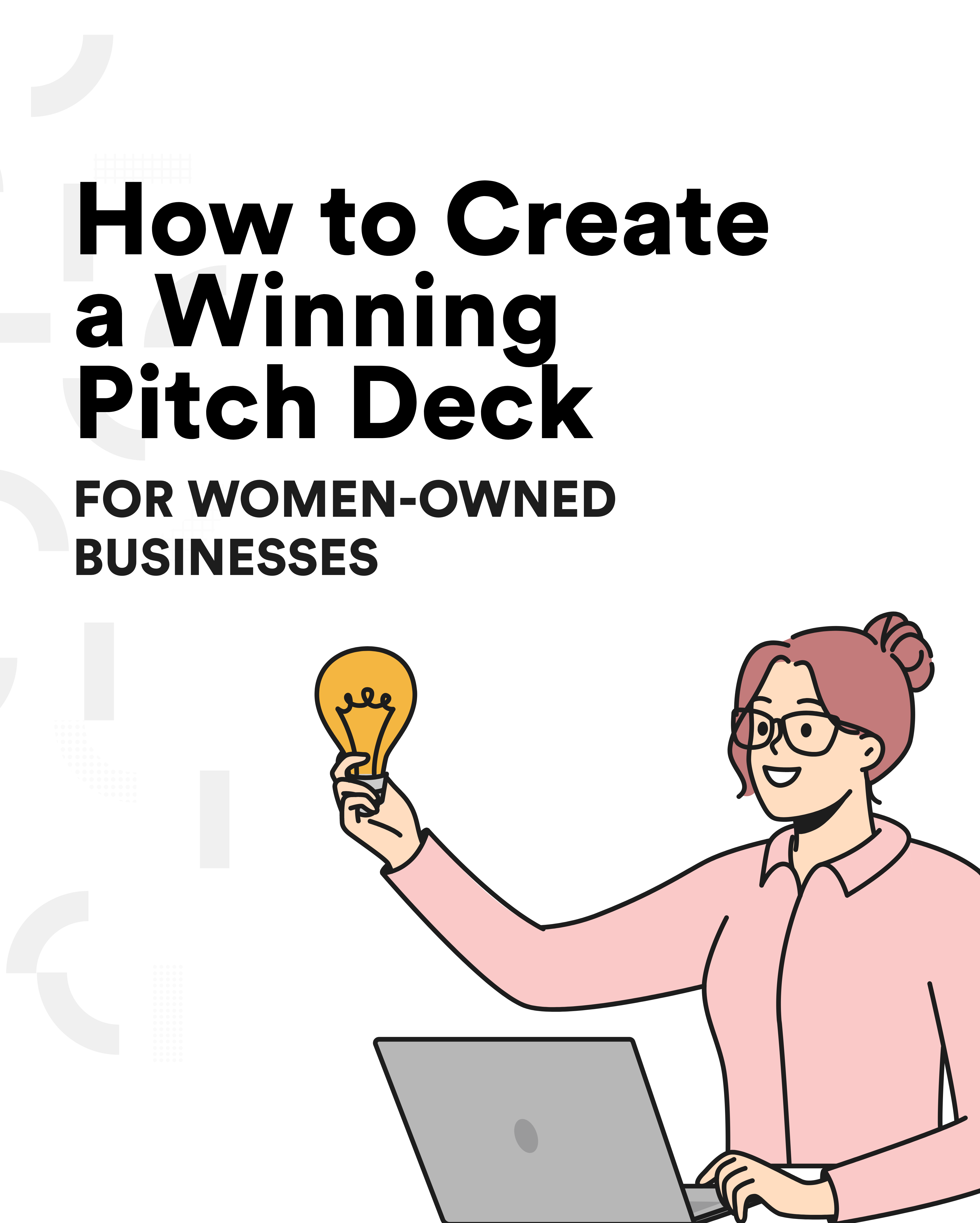
There is a gender gap regarding venture capital (VC) funding. As female (co-)founders, how can you win the pitch and get the fund to scale up your business? The first thing you can do is make sure you create a winning pitch deck.
Why do so many founders, regardless of gender, try hard to create a winning pitch deck to get VC funding for their businesses? What happened to bootstrapping and profiting first?
Well, the thing is, it's not just about the money.
Closing the deal with VCs also gives you access to professional guidance on business strategy, operations and marketing, building your network, connecting with more investors and VC firms, and connecting with customers. That's why if you want to scale up fast, VC funding can be a good leverage.
However, it's still quite challenging for female founders to shake hands with VC investors. Even at the market's 2021 peak, female founders made up only about 9% of VC funding recipients, and early-stage funding for women-led startups declined again in 2024. Most of the capital that does reach female founders still lands at the angel or seed stage, so securing the next round is yet another bump in the road.
Knowing the challenge, let's level up our pitching game. Check out how you can create a winning pitch deck for female founders below.
What makes a strong pitch deck?
Investors get the first impression of your business through your pitch deck, that's why you can't afford to have a half-hearted presentation. As a rule of thumb to create a winning pitch deck, your presentation should:
Be concise and straightforward
A VC firm can get hundreds of startups and companies pitching to them every year, so ain't no investors got time for a 150-slide-long presentation. To create a winning pitch deck, make sure it's concise and doesn't blabber.
Convey related facts through data and numbers
Do your due diligence. Research, analyze, rinse, and repeat, so you really understand your business, market, and forecast. This knowledge will lead you to be confident and convincing when presenting your business.
Portray the emotional, human side
Unless your business is targeting robots and you're pitching to a bunch of decision-making machines, your pitch deck should have a touch of the emotional, human side. Introduce the people in your business (yourself as a female founder and your management team) and build real connections with the investors. This is especially important because the management team plays the most crucial role in whether or not the business will succeed.
And when presenting your data and numbers, do it in an engaging way with the power of storytelling. How do you do that, though? Try the following sequence to create a winning pitch deck.
Investors fund the story they can retell in their partner meeting without you in the room.
What is the best pitch deck sequence?
There's nothing worse than a vague, jagged presentation when you pitch your business model to VC investors. It creates an awful first impression: "This founder doesn't know her stuff. They haven't done enough research. I don't understand what they're trying to pitch", and other bad inner comments.
Conversely, a great sequence keeps your presentation flowing nicely and naturally, as well as allows the investors to understand and relate to your stories.
To create a winning pitch deck for female founders or women-owned businesses, follow this sequence:
Start with the topic
This should be on the first and/or second slides of your deck, so you can get straight to the point right after saying hi and introducing your team members. Remember to also emphasize your role as a female founder and why it matters.
How to do it
- Write your company in one sentence: who you help plus the concrete outcome.
- Put it on slide one with your logo and name, keeping the room's eyes on the words.
- Say your founder story in two sentences and why you are the person to solve this.
- Cut anything that is not the topic and save the detail for later slides.
See a worked example
For example, a founder building a payments app for freelance women might open slide one with a single line: 'We help freelance women get paid on time and save for retirement automatically.' The who and the outcome land before slide two, and because she lived the problem, her two-sentence founder story makes the claim credible rather than aspirational.
Tools to use
Sequoia's business plan outline and Y Combinator's pitch-deck guide to sharpen the one-sentence opener, and Pitch to build a clean title slide.
Steal our AI prompt
Act as a seed-stage VC seeing my company for the first time. Here is what we do: [describe your product, who it helps, and the outcome in a few sentences]. Write three one-sentence positioning statements I could use as the opening line of my pitch deck. Each must name who we help and the concrete result, in plain language with no buzzwords. Then tell me which one is clearest and why.
Discuss what the VC investors already know
This is where you bring up existing data and reports: general data, things that many people already know, what the investors want and the brief they gave you (if any), and such.
Keep this part within two slides so you don't bore them.
How to do it
- List three or four facts about your market a typical investor would already agree with.
- Attach a named source and date to each one, not a vibe.
- Keep it to two slides; this is the runway, not the destination.
- End on the gap those known facts leave open to tee up the next slide.
See a worked example
For instance, a founder in women's health might spend one slide on context the room already accepts: the category is large and growing, and telehealth adoption stepped up after 2020. Each point is tied to a named report and date, so investors nod along and the shared baseline is set before she introduces anything new.
Tools to use
CB Insights Research for market-size and State of Venture data investors already track, and Crunchbase for funding rounds and competitor activity in your space.
Steal our AI prompt
I'm pitching VCs in the [industry] space. List four to six widely-accepted facts about this market that an investor would already know and agree with, such as market size, adoption trends, or regulatory shifts. For each, name the type of source I should cite (an industry report, a government dataset) so I can verify it myself. Do not invent specific statistics; give me the claim and where to confirm it.
Bring up new things they don't know yet
This is where you present your research and findings. Show the investors the problem you've found in the market, within your target audience, and back it up with rational data. Again, don't go over two slides.
How to do it
- State the specific problem you found that the known data misses.
- Back it with your own evidence: interviews, survey results, or demand signals.
- Show one clear chart, not a wall of numbers.
- Land the 'so what': why this gap is worth funding now.
See a worked example
For example, after the known-market slide a founder might reveal a wedge from her own 40 customer interviews: a specific segment abandons existing tools at checkout for one repeatable reason. Framed as her primary research, it is a finding the investors have not seen in any published report, which is exactly why it earns attention.
Tools to use
Google Trends to chart rising demand as an outside signal, Typeform to run your own customer survey, and Pew Research Center for credible free data to frame the problem.
Steal our AI prompt
Here is the market problem I think I've found: [describe the specific problem and who has it]. Here is the evidence I've gathered: [paste survey results, interview notes, or trend data]. Help me turn this into one crisp insight slide: a single headline claim, the one chart that proves it, and a one-line 'why now'. Point out where my evidence looks thin so I can shore it up before I present.
Introduce your idea/business model
And here's where your business comes to save the day. Connect the dots between points two and three, present how your business model can solve the problem in the market, and show the investors how your company as a women-owned business matters in this context.
You also need to elaborate on:
- The short- and long-term strategies and goals
- The role of each management team member in these strategies and goals
- What support you need from the VCs
- How their support helps you reach your goals
This is an important part where you're "selling" your business. It's okay to elaborate a little, but let's not go over five slides.
How to do it
- Connect the known-market and new-insight slides to your solution in one sentence: 'so we built...'.
- Show the model plainly: who pays, for what, and how often.
- List short- and long-term goals and which team member owns each.
- State the ask and what the money specifically buys: runway, hires, milestones.
See a worked example
For instance, a founder might connect the dots on one slide: the known market plus her research gap equals her product. Then she shows the model plainly (who pays, how much, how often), a near-term goal such as reaching a set number of paying customers, and a specific ask, for example a round sized to fund roughly 18 months of build and two key hires.
Tools to use
Strategyzer's Business Model Canvas to map how the model makes money on one page, and Y Combinator's Guide to Seed Fundraising to size the round and frame the ask.
Steal our AI prompt
Act as a skeptical seed investor reviewing my business model. Here's my product and how it makes money: [describe the product, pricing, and who pays]. Here's my team: [list roles]. Here's what I want to raise: [amount and what it funds]. Stress-test it: which revenue assumptions look weak, is the ask proportionate to the milestones, and what's the first question you'd ask that I haven't answered? Keep it blunt.
Summarize the key points
To finish your pitch, create one slide that contains around five important points of your whole presentation. Let them sink in, and add a closing statement that convinces the VC investors why your business model works in the long run.
How to do it
- Pull the five points you most want repeated in the investors' internal meeting.
- Put them on one slide, one line each, with no new information.
- Close with a single forward-looking sentence on why this business lasts.
- Share the deck as a tracked link so you can see which points hold attention.
See a worked example
For example, a closing slide might distill the whole pitch to five lines: the problem, the insight, the model, the traction, and the ask, followed by one sentence on why this endures. The goal is that the investor walks out able to repeat those same five things in their partner meeting without your deck in front of them.
Tools to use
DocSend to share the deck as a tracked link and see which slides investors actually read, and Beautiful.ai to build a clean single-slide recap.
Steal our AI prompt
Here's the full narrative of my pitch: [paste your deck outline or key slides]. Distill it into a single closing summary slide of exactly five one-line points: problem, insight, solution and model, traction, and the ask. Add one closing sentence on why this business works long-term. Use plain, confident language and introduce no new claims that aren't already in the deck.
And that's how you create a winning pitch deck for women-owned businesses
It's not enough to just create a winning pitch deck, though. Your pitch deck is only the beginning. For the bigger picture on closing the funding gap, see our guide to funding for women entrepreneurs. Keep improving your public speaking and presentation skills so you can nail that presentation and seal the deal.
Keep reading
 Women-owned Business
Empowering Women Entrepreneurs: Expert Insight Into Capital Challenges and Funding
Women-owned businesses drive innovation and economic growth in the world of entrepreneurship. Despite their significant contributions, representing 39% of all US businesses and generating $2.7…
 Women-owned Business
Shaping the Future of Agency Leadership: Key Insights from OWN IT 2025
The recent OWN IT 2025 women's agency ownership summit brought together some of the industry's most innovative minds, offering deep insights into the evolution of agency management and growth…
 Women-owned Business
How to Find a Business Mentor for Women Entrepreneurs in 3 Ways
Mentorship has always been a big part of our growth as a company. Our CEO, Ari Krzyzek, began to find a business mentor more than a decade ago when Chykalophia was just a tiny seed in a big garden.…
See exactly where your site is losing conversions
Paste your URL and get an instant conversion score. No form to fill out, no sales call.
Weekly strategies for businesses building what's next.
The Next Draft: one email a week on turning B2B websites into pipeline. No fluff, unsubscribe anytime.