
The $500 Small Business Marketing Plan: 5 Pro Tips that Don't Include Burning Your Money
Small business marketing strategy should not be expensive. It's unwise to burn so much money when you're just starting out. Let's break down a relatively small marketing budget for your business:…
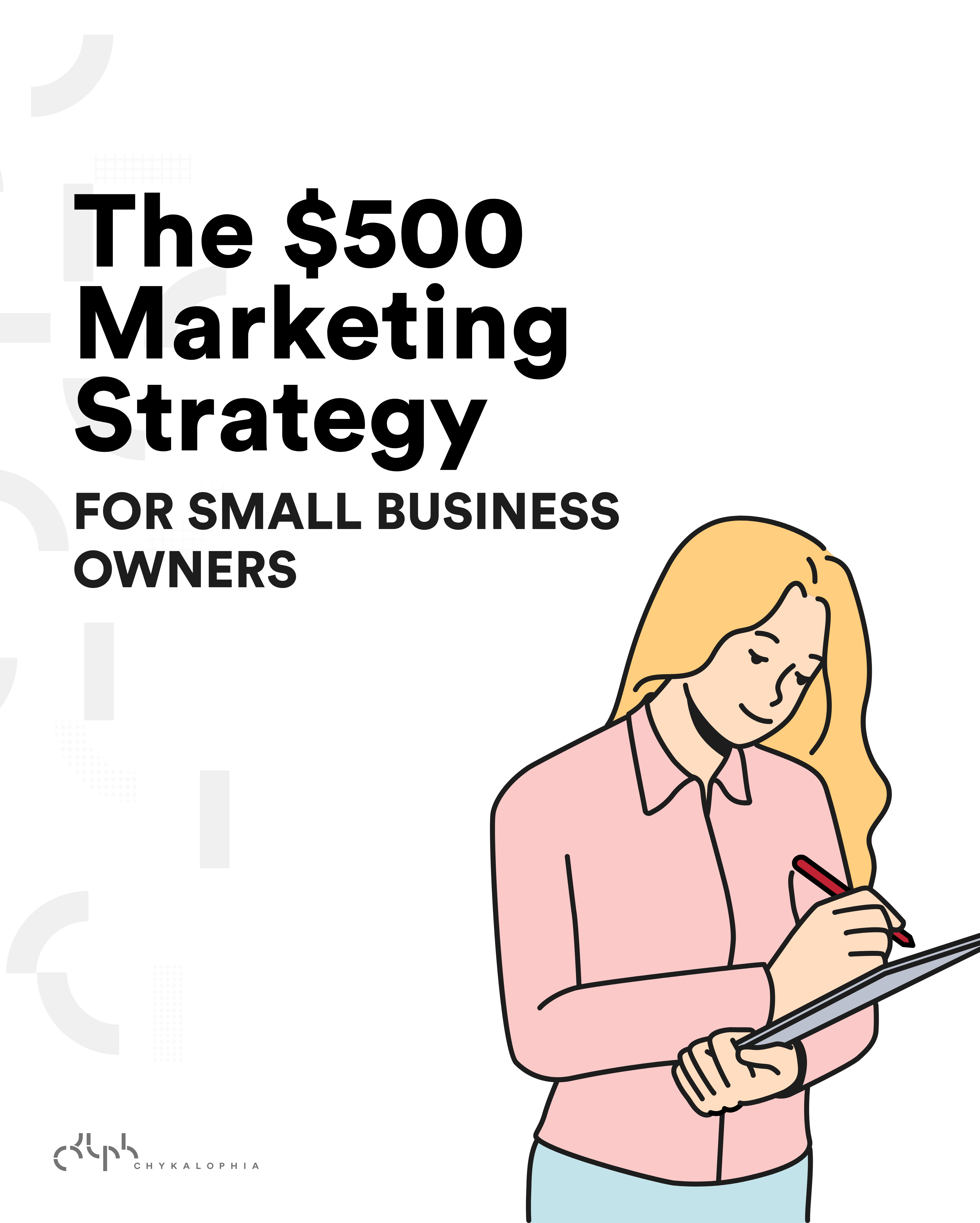
Small business marketing strategy should not be expensive. It's unwise to burn so much money when you're just starting out. Let's break down a relatively small marketing budget for your business: $500.
Big dreams, small budgets, limited time. Yeah, been there, done that.
Like many small business owners, we started Chykalophia with so many limitations. But we dreamed big. Still do. Some people called us the dreamers, but we were probably just naive.
Without proper financial and budget planning, our CEO had to take a full-time job while growing our small agency back then. But you don't have to follow our not-so-good example.
We've learned the hard way starting our small agency. We've also got guidance from amazing mentors and seniors in the industry, and now we'd like to show how you can start marketing your small business with just $500.
How much should a marketing budget be for a small startup?
Even established companies keep their marketing lean. Marketing budgets averaged just 7.7% of company revenue in Gartner's 2025 CMO Spend Survey, and half of the CMOs surveyed reported 6% or less. Your small business doesn't even have revenue yet, only projections, at best. So how much should you allocate for your small business marketing?
We don't believe it's wise to burn so much money at the beginning of your business. On the contrary, we're inviting you to be creative and find strategies to jumpstart your marketing with just $500.
A small budget isn't a marketing problem. It's a focus filter.
The $500-Small Business Marketing Strategy
Before we proceed, please note that $500 is generally considered low for a marketing budget. As a result, you will need to spare more time until you can see traction and results. We say six to twelve months would be a great start.
That being said, these five small business marketing strategies will work better if you're looking a slower yet steady, sustainable business growth. Now let's get to it.
Use free tools
Tools and software typically offer freemium plans that give you access to their basic services. Use them until your business needs more premium, advanced plans and you're ready to invest more.
Here are the tools we love and have been using:
- Canva, VistaCreate: Digital designing
- CapCut, InShot: Video editing
- ChatGPT: Content and copywriting
- Google Keyword Planner, Semrush: Content marketing and SEO
- MailChimp, Mailerlite: Email marketing
- WordPress: Create a website (without domain)
- Trello: Project management
While these free plans are good to help streamline your work, especially while you wear all the hats at the beginning of your business, we don't recommend using them in the long run as they're pretty ... basic. The more your business grows, it will need more advanced tools and software and you will want to invest in them.
COST: $0
How to do it
- Pick one free tool per job (design, copy, keyword research) instead of five overlapping ones.
- Batch a week of graphics in Canva's free plan so you are not designing daily.
- Pull keyword ideas from Google Keyword Planner to steer captions and blog topics.
- Track drafts and to-dos on one Trello board so nothing slips.
See a worked example
A solo founder launching, say, a candle brand could design a week of Instagram posts in Canva's free plan, draft the captions with ChatGPT, and check what phrases people actually search for in Google Keyword Planner, producing a full content batch without a single paid subscription.
Tools to use
Canva for free graphic design, Google Keyword Planner for free keyword research, and Trello to organize your marketing tasks.
Steal our AI prompt
I run a [describe your business] and post on [list your platforms]. Here are three offers or topics I want to promote this month: [paste]. Draft 12 short social captions I can lay out in Canva, grouped into 4 weekly themes, in a [describe tone] voice. For each caption, suggest one realistic keyword phrase a small business could rank for and note whether it fits Instagram, Facebook, or a blog post.
Learn from 3 marketing books
Ah ... books. Anyone who wants to grow should love reading, but not just any books. Just like anything else, we can't deny that there are overhyped, not-so-good books out there. Some other books have all the valuable knowledge but are insanely hard to read and understand.
But the right books can bring you to the places you want to be. The following books are our bibles. They are easy to read and light, yet packed with eye-opening knowledge and insights.
- The 1-Page Marketing Plan by Allan Dib ($14.88 for paperback)
- Revenue Growth Engine by Darrell Amy ($18.95 for paperback)
- Made to Sell: Creating Websites that Convert by our co-founders. You’ll find step-by-step guides on creating your website, from strategies and design, to development and goal tracking ($17.95 for paperback)
COST: $0 (Kindle) or $50 to $80 (paperback and hardcover)
How to do it
- Start with the Kindle editions to keep the cost near zero.
- Read The 1-Page Marketing Plan and fill in its nine-square canvas for your own business as you go.
- Pull three concrete actions from each book into your Trello board before opening the next one.
See a worked example
For example, you might read The 1-Page Marketing Plan first to sketch your whole funnel on a single sheet, then keep Made to Sell open as a checklist while you build the site, turning two paperbacks into an action plan rather than shelf decoration.
Tools to use
The 1-Page Marketing Plan to fit a whole strategy on one page, and our own Made to Sell for a step-by-step guide to a site that converts.
Steal our AI prompt
I just finished this marketing book and took notes: [paste your notes or a summary]. Turn its key ideas into a 5-step action list tailored to a [describe your business] with a budget under $500. For each step, tell me what to do this week, what it costs, and how I will know it worked.
Get involved in community meetups
Showing up and sharing about what you do may be one of the best small business marketing strategies you can do. Is it the easiest? Not really, especially if you're not comfortable being in a big group, or maybe new in town.
However, community meetups are not some uncharted territories. If you choose the right communities, you'll get to meet people from the same industry, who have been there longer than you are. Check out these local communities for women business owners with regular, productive meetups:
- NAWBO ($20-$30 per event)
- Female Founder's Collective (typically Free)
- Local Women Development Center in your area (typically Free)
COST: ~$50
How to do it
- Find one local group first: search the SBA Women's Business Center directory by ZIP code.
- Add a NAWBO chapter or Female Founder Collective event to round out the month.
- Before you go, prepare one useful thing to share, not just your pitch (see the pro tip above).
- Follow up within 48 hours with the two or three people you actually connected with.
See a worked example
A first-time founder new to town might, for instance, attend one free Women's Business Center workshop and one NAWBO chapter event in a month, walking away with two or three warm contacts instead of a stack of cold business cards.
Tools to use
The SBA Women's Business Centers directory to find free local counseling, NAWBO for local chapter events, and the Female Founder Collective for community and programming.
Steal our AI prompt
I run a [describe your business] in [describe your city] and I am attending a local business meetup for [describe the audience]. Write me a 30-second introduction plus three genuinely useful talking points I can share with other founders (not a sales pitch), and five open questions that start real conversations.
Organic social media marketing
When you're starting your small business marketing, don't immediately burn money on paid media. Doing so isn't wise as you don't know your audience yet. So for starters, look at small business marketing strategy #1 above. Use those tools to build your online presence on Facebook, Instagram, Twitter, Pinterest, and TikTok.
Review your engagement and growth on each platform every month. In about three to six months, you'll be able to decide which platforms don't work for your small business and target audience, and you can put them on hold.
COST: $0
How to do it
- Choose two platforms where your audience already spends time, not all five.
- Schedule a week of posts at once in Buffer's free plan or Meta Business Suite (free for Facebook and Instagram).
- Review reach and engagement every month and cut whatever is not working.
See a worked example
For example, rather than posting to five networks at once, you might commit to Instagram plus one other platform for 90 days, schedule everything a week ahead in Buffer's free plan, and drop whichever platform has not earned engagement by the review.
Tools to use
Buffer to schedule organic posts from one place, Meta Business Suite for free Facebook and Instagram scheduling, and Later for visual scheduling on Instagram, TikTok, and Pinterest.
Steal our AI prompt
Here is what my small business does: [describe]. My target customer is [describe]. Recommend the two social platforms worth focusing on and why, then give me a 4-week organic content calendar (3 posts a week) I can schedule in Buffer, mixing educational, behind-the-scenes, and offer posts.
Build an inexpensive website
Unfortunately, there aren't free tools to build an actual website, but you can create an inexpensive one effortlessly, even without learning to code. Here are our recommended software and their starting prices:
- WordPress domain: from $39/year
- Elementor WordPress hosting: from $119/year
- Elementor page builder plugin: from $59/year
- Shopify e-commerce builder: from $228/year
- Squarespace website builder: from $192/year
By now, you may wonder if it's really necessary to build a website in the early stage of your business. After all, it's still a small business, right?
Yes, you're currently building a small business, but a website is paramount for your business growth and scale-up in the future. If you're still hesitant, check out this article. It will tell you in detail why your small business marketing needs to include having a website, and the step-by-step of creating one.
COST: ~$250 tops
How to do it
- Decide first: WordPress plus Elementor if you want control, Squarespace or Shopify if you want everything bundled.
- Buy only the domain and hosting to start, and add premium plugins later.
- Map your five core pages (home, about, services, proof, contact) before you touch the builder.
- Give each page one clear call to action so the site converts, not just exists.
See a worked example
As an illustrative build, a founder might pair a WordPress.org install with the Elementor page builder to launch a five-page site for well under the $250 ceiling above, or skip the plugins and start a Squarespace trial if they would rather not manage hosting.
Tools to use
WordPress.org with the Elementor page builder if you want control, or Squarespace if you'd rather not manage hosting.
Steal our AI prompt
I am building a website for my [describe your business]. Draft the sitemap and the exact page sections for a lean 5-page site (home, about, services, proof, contact). For the homepage, write the hero headline, subhead, and one primary call to action aimed at [describe your ideal customer]. Keep the tone [describe].
Small business marketing shouldn't be costly
In total, you still have around $100 left on your marketing budget, which you can allocate on getting premium or advanced plans on your most-used software, hire a project-based freelancer, buy a couple more books, or attend more events.
While marketing is important, it is paramount to have a reasonable budget. Remember that other than marketing, you need to set aside other budgets, too, such as production, operation, R&D, and more. So don't get overexcited with marketing that you forget other aspects of your business.
Keep reading
 Women-owned Business
Trump Tariffs Survival Guide: 3 Ways Small Businesses Can Adapt
Update: As of April 24, Donald Trump said he could re-impose “reciprocal” tariffs on certain countries within two to three weeks, signaling a potential escalation in global trade tensions. Trump…
 Women-owned Business
How to Find a Business Mentor for Women Entrepreneurs in 3 Ways
Mentorship has always been a big part of our growth as a company. Our CEO, Ari Krzyzek, began to find a business mentor more than a decade ago when Chykalophia was just a tiny seed in a big garden.…
 Women-owned Business
5 Networking Tips for Women of Color Entrepreneurs
Is your network truly your net worth? Regardless, business owners and entrepreneurs are often on the lookout for networking tips, even more so those that belong to minority groups such as…
See exactly where your site is losing conversions
Paste your URL and get an instant conversion score. No form to fill out, no sales call.
Weekly strategies for businesses building what's next.
The Next Draft: one email a week on turning B2B websites into pipeline. No fluff, unsubscribe anytime.