
5 Strategies to Fuel Your Startup Growth with Gen Z & Millennial Talents
Mindset, perspective, and working style differences across generations might present a challenge in your company. Thus, it's important for you business owners to come up with effective strategies to…
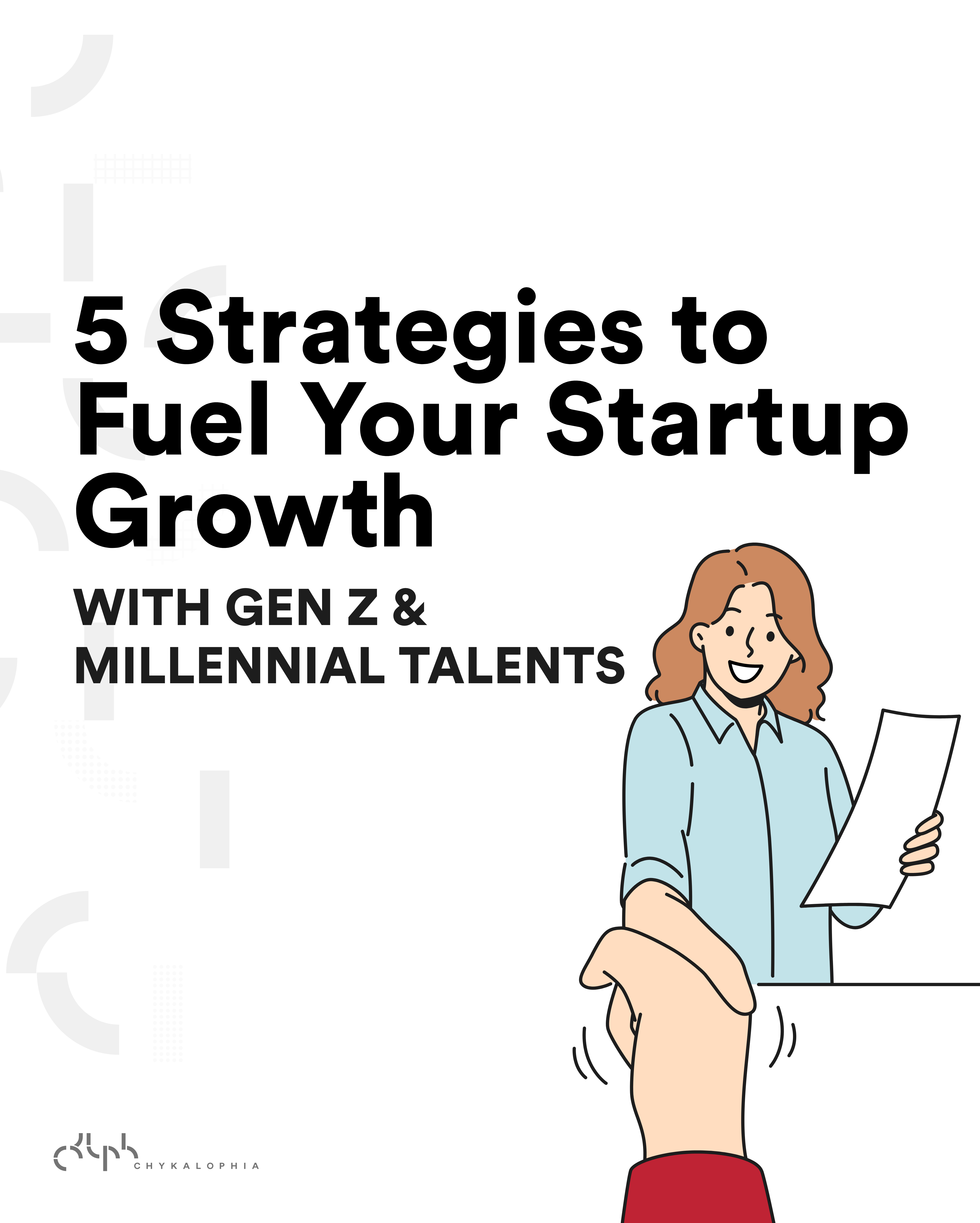
Mindset, perspective, and working-style differences across generations can present a challenge in your company. That makes it important for business owners to come up with effective strategies to embrace those differences, so you can boost your startup growth with Gen Z and millennial talents.
A bunch of entitled job-hoppers who give nothing beyond the bare minimum.
Ouch! What a cruel stereotype!
For the last few years, stereotypes and memes of Gen Zs and millennials in the workplace have been going around the internet. And people seem to love them, resorting to age and generation discrepancy to justify differences in mindset and styles of work.
Of course, we disagree with generalizations like this. After all, our business success, especially startups, is greatly dependent on the Gen Z and millennial workforce. These younger generations now make up 46%, or almost half, of the U.S. workforce. There's no way you, as a business owner, can avoid working with them.
In fact, you might be a millennial yourself. Our team at Chykalophia also comprises mostly millennials, and a few Gen Zs.
In spite of that, our team barely faces any challenges regarding work ethics. It all goes back to each individual talent and how you create a comfortable workplace for all, not just cater to a certain generation of cohort. Here's how you can fuel your startup growth with Gen Z and millennial talents.
There's no such thing as a Gen Z problem. There's only a workplace people don't want to stay in.
5 strategies to boost your startup growth with Gen Z and millennial talents
The first thing to do to fuel your startup growth with Gen Z and millennial talents is to achieve a healthy workplace within your company. This will help you attract top talents and retain them so you can grow your startup business long-term.
Here are the five effective strategies to do so:
Prioritize wellness, both mental and physical
We know how Gen Zs and millennials highly value mental health, so much that the term strawberry generation surfaced. Let's look at their perspective, though.
The increasing cost of living, climate change, and inflation threats have been a big burden on the young shoulders, making high-stress levels a regular companion. Deloitte's 2024 survey found that 40% of Gen Zs and 35% of millennials feel stressed all or most of the time, down from 46% and 39% a year earlier but still a defining pressure. Knowing this, isn't it reasonable that Gen Zs and millennials are very aware of mental health?
Feel stressed all or most of the time
However, mental and physical wellness are tightly linked, so we suggest prioritizing both. For your reference, here are some things we apply at Chykalophia to support mental and physical health:
- Menstrual leave for the ladies
- Gathering for our local team members
- Online game time
- Paid day-offs or vacation time
- Quarter reviews with direct managers, discussing current professional and personal sentiments
How to do it
- Fund one mental and one physical benefit you can afford this quarter (a meditation-app seat, a wellness stipend).
- Add a standing wellbeing question to your regular 1:1s or a short pulse survey.
- Act on one recurring theme within two weeks so people see it counts.
See a worked example
As an illustration, a five-person startup might run a monthly no-agenda wellbeing check where each person rates their week 1 to 5 and names one thing draining them. Over a quarter, a pattern like Friday deploy crunch tends to surface and becomes fixable.
Tools to use
Calm Health for Employers for a mental-wellness benefit a small team can offer, Culture Amp pulse surveys for quick recurring check-ins, and the Deloitte 2024 Gen Z and Millennial Survey for the data behind why this matters.
Steal our AI prompt
Act as an HR advisor for a [describe team size and stage] startup with a [paste budget] wellbeing budget. Given our current benefits [paste list], propose three low-cost mental and physical wellbeing initiatives we could start this quarter, each with a rough cost, an owner, and one signal that tells us it is working. Keep it practical for a small team.
Be a value-driven organization
More and more millennials & gen Zs make their career decisions based on their personal values. This is yet another reason for you to revisit your business values and missions, and see if your startup has been true to them.
Maybe your startup aims to provide easy access to health for minority women, reduce plastic waste and carbon footprint, provide free education for young women, or support animal welfare. Whatever it is, do walk the talk. Show that you're genuine through your business ethics, branding, and CSR programs. You'll eventually attract top talents with the same values, who want to improve themselves along with your startup business.
How to do it
- List your three to five stated values and, next to each, one recent decision that proves or contradicts it.
- Fix or drop any value you cannot back with evidence.
- Run the free B Impact Assessment to benchmark where you actually stand on workers, community, and environment.
- Publish the honest version on your careers page, not the aspirational one.
See a worked example
As an illustration, a startup that claims sustainability could audit one real decision, say switching to a supplier that costs 8% more but cuts packaging waste, and publish the trade-off. Candidates who share the value tend to notice the receipts, not the slogan.
Tools to use
B Corp certification as the recognized standard for social and environmental performance, and the free B Impact Assessment to benchmark before you commit.
Steal our AI prompt
You are a brand strategist. Here are our startup's stated values and mission [paste]. Here are five real decisions we made last quarter [paste]. For each value, show where our actions back it up and where they contradict it, then rewrite the values so they are specific enough that a skeptical candidate would believe them.
Lead humanely
No one wants a perfect leader and there is no such thing, so don't try to be one. People, not just Gen Zs and millennials, want to work with someone they can relate to. And being flawed shows that you, despite being their leader, are just another human being trying to figure things out.
As a woman business owner, leading with a touch of positive emotion can also benefit your relationships with your talents, especially with the nature of startups, where your business will face unexpected challenges and changes. It's okay if you don't know how to deal with them yet. Communicate it with your teammates, continue to upskill yourself, and learn together with your team as your startup reaches new milestones.
How to do it
- In your next 1:1, ask one real question about how the person is doing before any status update.
- Share one thing you are unsure about or got wrong, so honesty runs both ways.
- Give feedback that both cares personally and challenges directly, instead of sugar-coating or bluntness.
See a worked example
For example, a founder who says in a team meeting, "I got the pricing call wrong last month and here is what I learned," tends to earn more candid pushback afterward than one who projects certainty. People mirror the openness they see.
Tools to use
Radical Candor for Kim Scott's care-personally-and-challenge-directly framework, and 15Five to structure the weekly check-ins.
Steal our AI prompt
Act as a leadership coach. I am the founder of a [describe] startup and want to lead more humanely without losing accountability. Here is a recent situation where I had to give hard feedback [paste]. Rewrite how I could have handled it using the idea of caring personally while challenging directly, and give me three opening lines I could actually say.
Flexibility is key
You've read in point one that stress level is high among Gen Zs and millennials and that financial concerns are one of the causes. That being said, flexibility allows them to take on a second job for an extra source of income, as roughly 25% of millennials and nearly 30% of Gen Zs have done.
Flexible work schedules, flexible locations, and flexible working styles can help you attract top talents and retain them. It allows your team member to have a better work-life balance, so they can do their hobbies, spend time with their loved ones, work on their personal goals, take on a second job, and more.
How to do it
- Define a small window of required overlap and make everything outside it flexible.
- Move status updates and demos to async video so schedule and location stop blocking work.
- Protect at least one no-meeting block each week for focused work.
- Write the policy down so flexibility is a norm, not a favor people have to ask for.
See a worked example
As an example, a distributed team might set core overlap hours of 10am to 1pm in one shared time zone and move the rest async through recorded walkthroughs. People keep a school run or a side gig, and decisions still get made because context lives in writing and video, not a meeting.
Tools to use
Loom to replace some meetings with recorded walkthroughs, and Buffer's State of Remote Work for data on the flexibility remote workers actually want.
Steal our AI prompt
You are an ops advisor for a [describe size] distributed startup spread across [paste time zones]. Design a flexible-work policy that sets minimal required overlap hours, moves specific rituals like standup, demos, and reviews to async, and protects focus time. Output a one-page policy plus a short Slack message announcing it to the team.
Support any kind of development
We truly believe that improved team members improve the company. But let's not tell them what to do because no one likes being told what to do. Remember when we were kids and our parents would tell us to stop watching TV and start making the bed?
Instead, with a certain budget, our company policy allows all team members to choose their preferred training or course. This way, everyone can gain new knowledge and improve themselves on things that really matter to them, not just because they're forced to do so.
How to do it
- Set a per-person annual learning budget, however small, and let people pick the course.
- Offer a self-serve catalog like LinkedIn Learning, Coursera, or Udemy Business so choosing is easy.
- Ask each person to share one takeaway back to the team so the spend compounds.
See a worked example
For instance, giving each person a modest annual learning budget they choose how to spend, one picks a management course and another a design certificate, tends to beat a mandatory all-hands training nobody asked for, because people finish what they chose.
Tools to use
LinkedIn Learning, Coursera for Business, and Udemy Business as self-serve course catalogs people can pick from.
Steal our AI prompt
Act as an L&D advisor for a small startup. We have a [paste amount] per-person annual learning budget. Here are our team's roles and growth goals [paste]. Recommend a simple self-serve development policy covering how the budget works, which platforms to offer, how people request it, and a lightweight way to share what they learned. Keep admin overhead minimal.
Attract top talents and retain them so you can grow your startup business
With so many jobs available globally today, it can be easy to lose a top team member if you're not careful. And retention is paramount if you want to grow your startup business because recruitments are madly expensive. It can cost three to four times the position's salary to hire a new team member, so imagine doing that repeatedly within a year because your team members don't last long.
To sum up, if you want to fuel your startup growth with Gen Z and millennial talents, do attract top talents and maintain good retention by creating a healthy company culture. If your team is distributed, our tips on remote team collaboration build on the same idea. This allows you to grow your startup business, and you get to support your teammates' individual development, too. How cool is that!
Keep reading
 Women-owned Business
Empowering Women Entrepreneurs: Expert Insight Into Capital Challenges and Funding
Women-owned businesses drive innovation and economic growth in the world of entrepreneurship. Despite their significant contributions, representing 39% of all US businesses and generating $2.7…
 Women-owned Business
How to Find a Business Mentor for Women Entrepreneurs in 3 Ways
Mentorship has always been a big part of our growth as a company. Our CEO, Ari Krzyzek, began to find a business mentor more than a decade ago when Chykalophia was just a tiny seed in a big garden.…
 Women-owned Business
5 Networking Tips for Women of Color Entrepreneurs
Is your network truly your net worth? Regardless, business owners and entrepreneurs are often on the lookout for networking tips, even more so those that belong to minority groups such as…
See exactly where your site is losing conversions
Paste your URL and get an instant conversion score. No form to fill out, no sales call.
Weekly strategies for businesses building what's next.
The Next Draft: one email a week on turning B2B websites into pipeline. No fluff, unsubscribe anytime.