
5 Tips to Win Back Lost Customers and Regain Customer Trust
Losing customers is an inevitable challenge. Whether due to a subpar customer experience, product issues, or intense market competition, customer trust can dwindle. However, the art lies in not just…
Losing customers is an inevitable challenge. Whether due to a subpar customer experience, product issues, or intense market competition, customer trust can dwindle. However, the art lies in not just acquiring new customers but in the ability to win back those who have strayed. Let's explore five practical tips to regain customer trust and win back lost customers.
Understanding why we could lose customers
Before diving into the strategies to win back lost customers, it's crucial to understand the reasons behind customer defection. Here are the most common factors as surveyed by EMARKETER. We're going to cover five of them below.
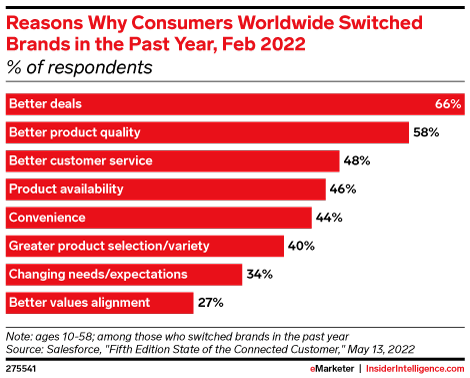
-
Poor customer experience: Unresolved issues, slow response times, or inadequate customer support can lead to dissatisfaction. When customers face problems that linger without resolution, experience delays in responses, or encounter ineffective support systems, it creates frustration and a sense of neglect, reflecting poorly on the brand's commitment to customer satisfaction.
-
Product or service problems: Issues such as defects, lack of features, or failed expectations with products or services can significantly impact customer satisfaction. Defective items, products lacking essential features, or unmet expectations erode trust and confidence, leaving customers feeling dissatisfied and potentially seeking alternatives.
-
Competitor appeal: A competitor offering a more attractive alternative is a common driver for customer defection. In a competitive market, effective marketing by rivals, showcasing superior features, pricing, or value propositions, can draw customers away. Failing to match or counter these efforts may result in lost customers.
-
Communication breakdown: Lack of personalized communication or failure to address customer needs contributes to disengagement. Customers value personalized communication that acknowledges individual preferences. When communication lacks personalization and fails to address evolving needs, it can lead to a breakdown, with customers perceiving a lack of genuine interest from the brand.
-
Changing needs or preferences: Customer needs and preferences evolve, and brands that fail to adapt risk losing customers to competitors. Failing to innovate and align offerings, services, or communication strategies with changing preferences may lead to a brand becoming irrelevant.
The wait, not the bug, is usually what pushes a customer out the door.
5 practical tips to win back lost customers
Losing customers, while sucks, is not the end of the world. Here's how you can regain customer trust and even nurture it for better relationships in the future:
Communicate and resolve issues promptly
Addressing customer issues promptly and communicating proactively is essential to win back lost customers. Rapid resolution shows your commitment to customer satisfaction, and transparent communication about the steps taken to fix the problems reinforces your brand's responsiveness.
To achieve this, we advise implementing robust customer support channels, leveraging automation for real-time issue tracking and resolution, and openly communicating the measures taken to address concerns.
How to do it
- Pull every support channel into one shared inbox in Help Scout or Zendesk so no request sits unowned.
- Set an SLA trigger for high-stakes tags (billing, outage, cancellation) and route each to a named owner.
- Once the fix is live, send affected customers a plain "here is what we changed" note, not just a ticket-closed autoreply.
See a worked example
For example, a small B2B SaaS team might set a rule that any support email tagged "billing" or "outage" gets a first human reply within two business hours, followed by a short note once the fix actually ships. A move this simple often changes how a frustrated account remembers the whole episode, because the wait, not the bug itself, is usually what pushed them toward the exit.
Tools to use
Help Scout or Zendesk to pull every support channel into one shared inbox and trigger SLAs on high-stakes tickets.
Steal our AI prompt
Act as a customer support lead. Here is a frustrated or lapsed customer's history: [paste the full ticket thread and account notes]. Draft a proactive win-back message that (1) acknowledges the specific issue they hit, (2) states plainly what we changed or fixed, and (3) offers one concrete next step. Keep it under 120 words, no marketing hype, and match this tone: [describe your brand voice].
Personalize offers and incentives
Personalized incentives, such as tailored discounts, loyalty perks, or personalized recommendations, demonstrate to customers that they are valued, encouraging them to reconsider their relationship with your brand.
To implement this, you can analyze customer purchase history for insights into preferences and behaviors, providing exclusive discounts or incentives that align with individual customer profiles.
How to do it
- Build a lapsed-buyer segment in Klaviyo (bought once, no order in 60 to 90 days) so the offer only reaches people who actually left.
- Tie the incentive to purchase history, a refill, an upgrade, or a complementary item, not a blanket sitewide code.
- Give returning customers a reason to stay with a points or VIP tier in Smile.io so the win-back is more than a one-time bribe.
See a worked example
For example, an ecommerce brand might pull everyone who bought once in the last year but has not returned in 90 days, then send that segment a single offer tied to what they actually bought, such as a refill reminder paired with a modest returning-customer discount. Framing the incentive around their past purchase, rather than a generic sitewide blast, is usually what makes a win-back offer feel earned instead of desperate.
Tools to use
Steal our AI prompt
You are a lifecycle marketing strategist. Here is a segment of lapsed customers and their purchase history: [paste or describe what they bought, average order value, and time since last order]. Propose three win-back offer angles tied to what they already purchased, each with a subject line and a 40-word email body. Avoid discount-only thinking and hype. Our brand voice: [describe].
Revitalize the customer experience
Enhancing the overall customer experience is crucial to regain customer trust. An improved experience showcases your commitment to customer satisfaction. To revitalize the customer experience, you can optimize website and app interfaces for seamless navigation, try using a machine-learning tool to improve it even better, actively gather and act on customer feedback for continuous improvement, and implement loyalty programs to foster a positive and rewarding relationship with your customers.
How to do it
- Watch Hotjar heatmaps and session recordings for the paths returning users take, and note where they stall or rage-click.
- Run a short remote usability test in Maze on the single flow that leaks the most, before committing to a rebuild.
- Add a one-question on-site survey ("what almost stopped you today?") so you act on stated friction, not guesses.
See a worked example
For example, if session recordings show returning visitors repeatedly abandoning at the same checkout step, that friction point is often a bigger win-back lever than any discount, because you are removing the reason they left rather than paying them to overlook it. A quick round of usability tests on that one flow can surface the fix before you spend on a full redesign.
Tools to use
Steal our AI prompt
Act as a UX researcher. Here are notes from our session recordings and on-site survey for returning customers: [paste the friction points, drop-off steps, and any verbatim quotes]. Identify the top three experience problems most likely to push a returning customer away, rank them by likely impact and effort to fix, and suggest one testable change for each. Be specific and skip generic best-practice filler.
Rebrand and reinvent your messaging
Reinventing brand messaging is a strategic approach to showcase positive changes and alter customer perceptions. Craft a compelling narrative around your brand improvements, highlight positive customer stories and testimonials, and redefine your brand values and commitments. A refreshed brand image can rekindle interest and showcase a commitment to continuous improvement, influencing lost customers to reconsider their engagement with your brand.
How to do it
- Collect fresh proof of the change: gather video and text testimonials with Senja from customers who saw the improvement firsthand.
- Rewrite your core message using the StoryBrand framework so the customer, not your brand, is the hero of the turnaround.
- Lead win-back touches with a concrete "what changed" narrative and matching testimonials, not a generic rebrand announcement.
See a worked example
For example, a brand that fixed a well-known reliability problem might build its win-back message around proof rather than promises, leading with a short video from a customer who churned and came back, followed by a plain "here is what changed" timeline. A testimonial from someone who had the exact objection the lapsed customer had tends to do more work than a polished new tagline.
Tools to use
Senja to collect video and text testimonials as proof of the change, and StoryBrand for a messaging framework that casts the customer as the hero.
Steal our AI prompt
You are a brand messaging strategist working in the StoryBrand framework. Here is what our brand used to be known for, what we changed, and the proof we now have: [describe the old perception and the specific improvements, and paste any testimonials]. Write a one-paragraph win-back narrative plus three short soundbites that cast the customer as the hero and our fix as the guide. No hype, no vague adjectives.
Continuous engagement and feedback integration
Maintaining regular communication and fostering ongoing engagement is critical for preventing customer drift and creating opportunities for feedback. Try implementing email newsletters, engage customers on social media with targeted promotions, and actively seek and respond to customer feedback.
Monitoring customer sentiment through surveys and social listening tools will help you stay attuned to your customer perceptions, facilitating continuous improvement and relationship-building efforts. If you aim to regain customer trust, consistent engagement is the main key.
How to do it
- Schedule a light, value-first email and social cadence so re-engaged customers hear from you before they need something, not only when you are selling.
- Send a short Typeform survey at set milestones (30 and 90 days) to catch dissatisfaction while it is still fixable.
- Track brand sentiment and mentions in Brand24 and route negative signals to a human for a direct reply, not an autoresponder.
See a worked example
For example, a team might set a simple cadence where every won-back customer gets a short survey 30 days after returning, and any dip in sentiment picked up by social listening triggers a personal check-in rather than another promo. Staying in low-key, useful contact is usually what keeps a recovered relationship from quietly lapsing a second time.
Tools to use
Steal our AI prompt
Act as a retention program designer. Here is our current post-purchase communication and any feedback we collect: [describe or paste your email cadence, survey questions, and recent customer sentiment]. Design a 90-day engagement plan for recently won-back customers that mixes value-first touches with two feedback checkpoints, and specify what signal should trigger a human outreach. Keep it practical and low-volume.
Lost customers are not a lost cause
Rebuilding trust and winning back lost customers requires a strategic blend of proactive communication, personalized incentives, and a commitment to continuous improvement. As long as you understand why customers switch to other brands, you can implement the right actions to regain customer trust and establish long-term loyalty.
The math rewards the effort: Frederick Reichheld's research at Bain and Company found that lifting customer retention by just 5 percent raises profits anywhere from 25 to 95 percent, because a re-earned relationship keeps paying back rather than converting once (Harvard Business Review, 2014).
Remember, every lost customer is a potential opportunity for redemption and growth. If you want a site and funnel built to re-earn that trust and convert it, that is exactly what our Conversion System is for.
Keep reading
 Branding & Digital Marketing
Unraveling 5 Secrets of Consumer Buying Decision Process
Does your business face the challenge of capturing the attention and loyalty of consumers? Understanding the intricacies of the consumer buying decision process is crucial for creating effective…
- Branding & Digital Marketing
Brand Is a B2B Growth Lever, Not a Paint Job
Brand gets filed under the soft stuff right up until you see the numbers. Here is the hard business case for brand in B2B, and how to run it like the revenue engine it is.
 Branding & Digital Marketing
From Typography to Tone: How to Create a Brand Voice
It's paramount to create a brand voice for connecting with your audience. From choosing the right typography to setting the tone of your messaging, every element plays a crucial role in shaping your…
See exactly where your site is losing conversions
Paste your URL and get an instant conversion score. No form to fill out, no sales call.
Weekly strategies for businesses building what's next.
The Next Draft: one email a week on turning B2B websites into pipeline. No fluff, unsubscribe anytime.